
THE BOYS’ ROOM INSIGHTS
Student Growth & Development
Helping Boys Find Their Voice
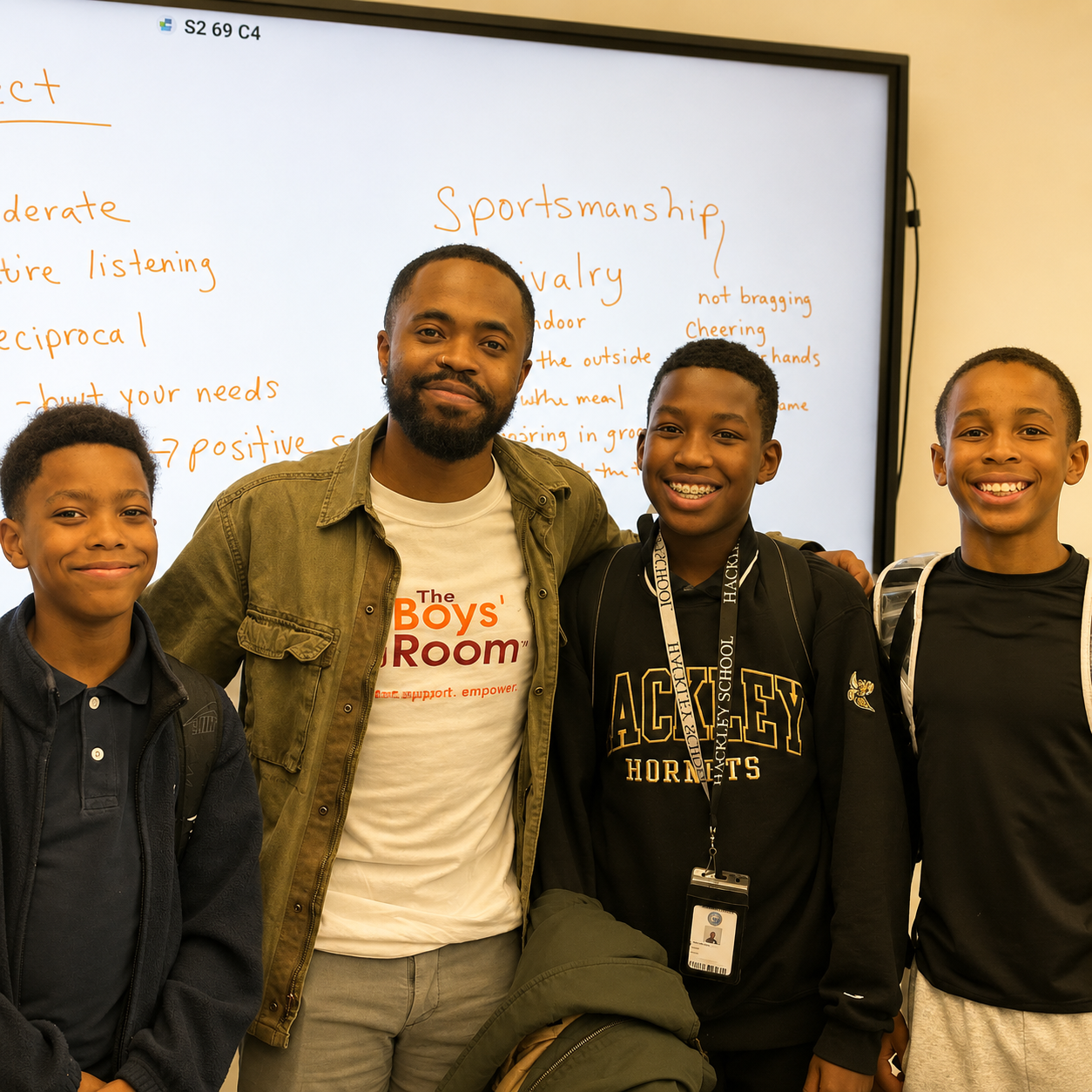
Finding your voice develops through repeated opportunities to express what you think, ask for what you need, and stay present when a conversation feels uncomfortable. For boys, those opportunities can happen at home, in school, with friends, and in spaces where trusted adults make room for honest participation.
Adults often notice a young person’s voice most clearly when he speaks confidently in front of a group. There are quieter forms of self expression that matter just as much. A boy is using his voice when he tells a teacher that he does not understand an assignment, lets a friend know that something bothered him, shares an idea that may be unpopular, or asks an adult for support.
These moments require practice.
Voice grows when boys know their words will be taken seriously
Young people pay close attention to what happens after they speak.
They notice whether someone listens long enough for them to finish. They notice whether a question is welcomed or dismissed. They notice how adults respond when their perspective differs from everyone else’s.
Those responses influence what a boy decides to share the next time.
A young person who regularly experiences thoughtful listening begins to learn that speaking has value. He also learns that he can participate in a conversation even when his thoughts are still developing.
Adults can encourage this by staying curious about what a boy is trying to communicate. A simple follow up question such as, “Tell me more about what you mean,” can create enough room for a short answer to become a fuller conversation.
Asking for help is part of finding your voice
Some boys become comfortable handling problems independently before they become comfortable asking for assistance.
The ability to ask for help requires several skills. A young person has to recognize that he needs support, decide whom he trusts enough to approach, and find the words to explain what is happening.
That process can feel especially difficult when a boy believes other people expect him to already know the answer.
Adults can make help seeking more familiar by treating it as a normal part of learning and problem solving. When questions are received with patience, boys gain experience communicating what they need before frustration becomes overwhelming.
The goal is for a young person to develop language he can use across different situations.
He may eventually be able to say, “I need you to explain that another way,” “I’m having trouble with this,” or “Can I talk to you about something?”
Each of those sentences reflects a growing ability to advocate for himself.
Boys also need practice expressing disagreement
Having a voice includes learning how to communicate when you see something differently.
Disagreement can carry social pressure. A boy may worry about upsetting a friend, challenging an adult, standing apart from a group, or saying something imperfectly.
A supportive environment gives him opportunities to experience disagreement while maintaining connection.
This is where adults can model useful skills. We can show boys how to ask questions before making assumptions, explain a perspective clearly, and listen closely enough to understand someone else’s reasoning.
The experience teaches a young person that his contribution can remain valuable even when everyone does not reach the same conclusion.
A boy strengthens his voice every time he learns that he can speak honestly and remain connected to the people around him.
Give conversations enough time to develop
Adults sometimes ask good questions and move on too quickly.
A young person may need a few seconds to decide what he wants to say. He may begin with “I don’t know” because he has not organized his thoughts yet. A first answer may only reveal part of what he is experiencing.
Giving a conversation more room can change what comes next.
At The Boys’ Room, reflection and group conversation create recurring opportunities for boys to put experiences into words. The consistency matters. Boys do not have to communicate everything perfectly in one moment. They have another opportunity to reflect, listen, and contribute the next time the group comes together.
That repetition helps language become more accessible.
Pay attention to how a boy communicates most comfortably
Some boys process aloud. Others need time before they are ready to speak. Some communicate more easily during an activity, in the car, while walking, or in a one on one conversation.
Adults can learn a great deal by noticing those patterns.
Consider when a boy tends to share the most. Pay attention to who is present, what the environment feels like, and whether the conversation began directly or developed naturally while something else was happening.
Those observations can help adults create more opportunities for meaningful conversation.
A young person who gives brief answers across the dinner table may talk freely during a drive home. Another may participate actively in a small group and become quiet when the group gets larger.
Finding his voice includes discovering the conditions that help him use it.
The goal is a voice he can carry with him
A boy will eventually move through environments where the adults who know him best are not present.
He will need to introduce himself, ask questions, communicate boundaries, contribute ideas, navigate conflict, and seek support from people he may not know well.
The conversations happening now help prepare him for those moments.
Parents, educators, and mentors can support that development by creating regular opportunities for boys to speak and experience what happens when their words are received with attention.
Over time, a young person begins to understand that his perspective belongs in the conversation and that he has the ability to communicate it.
A useful question for adults to consider is: Where does this boy already use his voice freely, and what can that environment teach us about helping him use it elsewhere?
For the page layout, I’d place the pull quote after “Boys also need practice expressing disagreement”, which puts the visual break close to the middle of the article just like the first page.